
Greece, a Testing Ground for Smart Surveillance Technologies
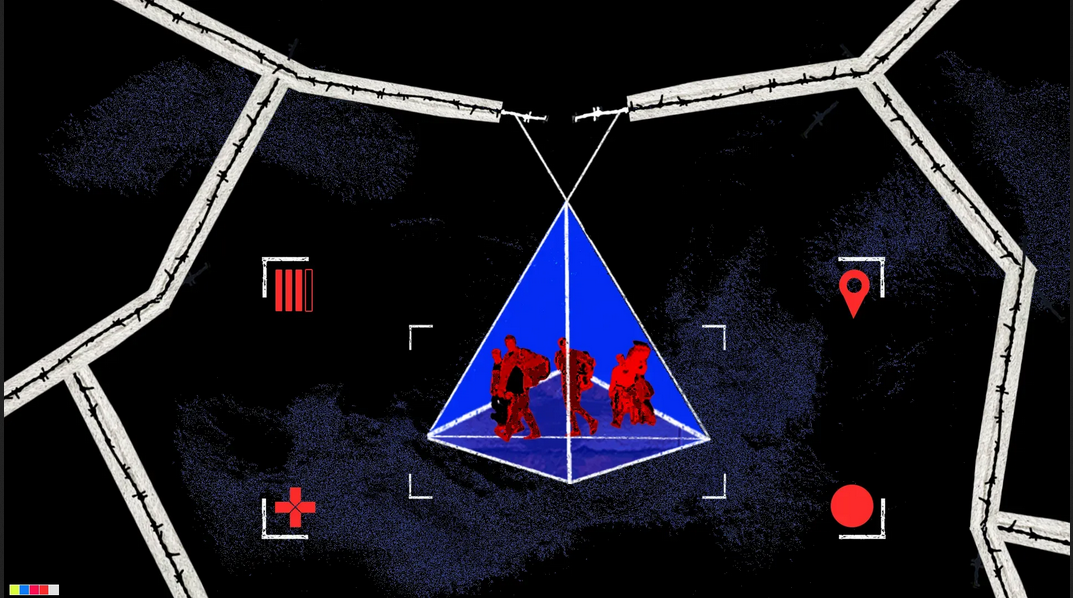
Europe is rapidly building an AI-ready smart-border regime — bankrolled by the EU, pushed by Germany and tested in Greece. Defense and security firms are among the biggest winners. Much of it is unfolding under the radar, with safeguards for people on the move lagging behind.
Border guards patrolling Greece’s frontier with North Macedonia to prevent irregular crossings have long relied on an unusual early-warning system: the storks nesting on a bridge over the Axios River. When the birds suddenly scatter, officers know someone is likely moving in the bushes below — usually migrants trying to slip out of Greece and head toward Northern Europe. Soon, their role will be obsolete.
Smart border technology, cameras, and drones, will take their place — tireless, unblinking, and financed by Brussels. Greece plans to extend the high-tech surveillance model it built along the Evros land border with Turkey — designed to stop asylum seekers entering the European Union — to its northern frontier. The aim this time is to seal the exit routes used for secondary movement toward Western Europe.
What is being planned here is part of a broader shift driven by Berlin, Brussels, and Athens: Germany wants fewer arrivals, the EU is funding new technologies, and Greece has become the test bed for Europe’s AI-enabled border regime.
This cross-border investigation by Solomon, Die Tageszeitung (Germany), SWI Swissinfo (Switzerland), and Inkstick Media (US) took us to eight countries — including on-the-ground reporting in seven — and involved interviews with more than two dozen officials, insiders, and frontline officers. We also reviewed hundreds of pages of public and internal documents, freedom-of-information request responses, procurement records, and technical documentation. Taken together, the findings show how Europe is rapidly building a smart border system, who profits from it, and what risks it creates. Among the key findings:
How Brussels’ efforts to seal the Balkan route, combined with Berlin’s demand to curb onward movement to Germany, are driving the expansion of Greece’s new border architecture;
Previously unpublished details about Greece’s plan to replicate the “Evros model” — the high-tech fence-and-sensor system along the Turkish land border — at its northern borders with North Macedonia and Albania;
How E-Surveillance, the EU-funded program backing Greece’s new automated border monitoring, reflects a wider European trend: powerful systems advancing with vague data rules and thin public oversight;
How defense giants, security firms, university labs, and research institutions, backed by an influential Brussels lobby, profit from a new ecosystem of EU-funded border projects.
Drones and AI at the border
Last September, senior EU border officials attended an internal meeting to be briefed on innovation at the headquarters of Frontex, the EU border agency, in Warsaw. According to participants, a Frontex-tested drone surveillance network was presented. It featured vertical-take-off (V-BAT) drones hovering along the Bulgarian-Turkish border, transmitting real-time video to a command hub where the system alerted the police about migrant-crossing attempts and “criminal activities.”
One of the contractors is Shield AI. The California-based company is run by a former Navy SEAL, Brandon Tseng. Tseng claimed that the 60-day pilot in Bulgaria — a country which, like Greece, is accused of systematically violating asylum seeker rights — significantly reduced irregular border crossings and crime, citing Bulgarian officials. Shield AI declined to answer questions about the system, its deployment, costs, or data use. Frontex confirmed in a written response that the pilot demonstrated a prevention effect “contributing to a visible reduction or temporary stop of criminal activities,” adding that the deployment had “comprehensive fundamental-rights safeguards” and that the preventive effect was “an indirect outcome.”
Such pilots illustrate the agency’s strategy for deploying “next-generation European border surveillance capabilities” across the EU’s external frontiers — and how pilots can be hard to distinguish from operational deployments.
Frontex has also created an internal AI Hub and an AI Roundtable to identify which of the agency’s AI systems could be classified as “high-risk” under the EU AI Act. According to the regulation, systems used in migration, asylum, and border control management “affect persons who are often in particularly vulnerable positions” and should, “in no circumstances,” be used either to circumvent asylum seeker rights such as through surveillance-assisted pushbacks, in which people located with the help of drones and sensors are forced back across the border before they can apply for international protection.
Frontex stated that it “does not operate or deploy high-risk AI systems.” Greece’s Hellenic Coast Guard also said it “does not operate artificial-intelligence systems” and that all procurements include data-protection clauses — even as it acknowledged using EU-provided “electronic platforms which have an AI mechanism.” The Coast Guard declined to specify which platforms it uses, citing the confidential nature of this information and the need to protect operations.
The choice of words is not accidental, as authorities prefer to talk about “algorithms,” “automation,” or “innovation,” says Dr. Niovi Vavoula, an Associate Professor and Chair in Cyber Policy at the University of Luxembourg. “They hide behind broader words to avoid scrutiny and to keep systems upgradeable without relabelling them as AI.”
The European Commission has said that, contrary to deployed systems, research pilots remain outside the full legal framework — a distinction that Vavoula calls increasingly untenable. Pilots at live borders now closely resemble operations, yet are still shielded from full transparency, data protection impact assessments and public scrutiny. In her view, once such systems are tested on real people in uncontrolled, active operations (as in the Bulgaria pilot), “we are past the purely testing research phase” and any research exceptions “shouldn’t be applicable.”
The Evros Model Goes North
Such concerns are often dismissed at a time when migration has been reframed as a security threat across Europe. “Everything to do with borders is being more and more exempt from democratic oversight, accountability, transparency,” said Bram Vranken, a researcher at Corporate Europe Observatory, a Brussels-based watchdog tracking tech and defense lobbying.
This new narrative is evident in the replication of the “Evros model” — the high-tech fence-and-sensor system Greece installed along its border with Turkey to spot and stop irregular migration, equipped with long-range cameras, thermal sensors, drones, and central command hubs.
Under the EU’s €35.4 million “E-Surveillance” program, Greece is bringing the Evros system to its northern borders.
Meeting minutes and technical and other documents reviewed for this investigation detail plans for Mobile Incident-Management Centers: 4x4 vehicles with thermal cameras, drones, and encrypted communications systems, operating alongside new fixed surveillance sites and feeding real-time alerts to regional and national command centers.
Internal documents describe these units as “essential” for monitoring blind spots where “no other advanced electronic or automated surveillance systems” exist.
Tender documents reviewed by our team include broad secrecy clauses and stiff penalties for disclosure — standard, officials say, for national security contracts. But the same documents are thin on key safeguards: for example, daytime footage has a 15-day deletion limit, but no such explicit rule exists for thermal images. Encryption and auditing requirements are exhaustive, while privacy and data protections for people caught in the system are not.
Dr. Vavoula calls this a “second black box”: technical opacity layered with legal omissions.
In Evros, the system has proven effective in deterring asylum seekers from reaching EU soil, according to Greek and EU officials, as shown in a previous Solomon investigation. Which is why Evros is now more of a blueprint than a test site: the same technology used to keep migrants out of Europe will be used to keep them inside Greece, limiting movement toward the Balkans and beyond.
For years, Greece resisted EU pressure to bolster checks at its northern exits. After a scathing 2021 Schengen evaluation, the EU demanded upgrades. The new system is expected to be fully operational in 2027. Police sources briefed on the plans say the system will automate what once depended on human observation: a crossing detected on thermal camera, auto-tracked by drone, and relayed to a rapid-response unit.
Ample funding and political pressure
Greece’s northern frontier has long served as a quiet exit route for people trying to reach Western Europe via the Balkan corridor, and Greek policy was to tolerate the movement to a degree, seeing it as a way to ease pressure inside the country.
Greece’s new rush to secure those exits is partly driven by German pressure, according to Greek migration and security officials involved in the deliberations. Berlin has taken one of Europe’s hardest lines on migration, tightening asylum rules and insisting on tougher border controls across the bloc.
When Germany’s new chancellor, Friedrich Merz, met Greek Prime Minister Kyriakos Mitsotakis in May 2025, the message was blunt: “Secondary migration from Greece to Germany must decrease. Returns must increase.” Germany received over 25,000 asylum applications in 2024 from people already recognized as refugees in Greece.
Asked by this investigation whether the German Interior Ministry could confirm that it was putting pressure on Greece, the official line was: “The Federal Government supports measures that contribute to an effective protection of the EU’s external borders and the fight against inhumane smuggling.”
A senior Greek official summed up the dynamics: “Brussels wants results. Berlin wants fewer arrivals. Athens delivers both — it is that simple.” The political pressure is palpable, driven by the fact that migration remains one of the top voter concerns across much of Europe.
Smart border winners
The EU money at stake is vast. For 2021-2027, Greece has over €1.5 billion in EU Home Affairs funding at its disposal. Greece’s border allocation (BMVI) is the largest in the EU. Its Home Affairs package is second only to Germany’s.
Our investigation found that much of it is earmarked for surveillance and automation:
a unified maritime surveillance system using radars, cameras, and patrol vessels;
new surveillance equipment;
encrypted police communications in border zones;
offshore patrol vessels with Vertical Take-Off and Landing (VTOL) drones;
€100 million to extend and equip the Evros fence.
Greek officials say one of the goals is full coverage of the land border with Turkey through a mix of personnel and high-tech detection systems. Some 2,000 border guards are currently deployed there, assisted “by technology, equipment, the fence, which is an important means of deterrence,” said Michalis Chrisochoidis, Greece’s civil protection minister.
Spending on high-tech deterrence dwarfs investment in search and rescue or services for asylum seekers. A Solomon investigation found that just €600,000 (or 0,07 percent) of total EU border management funding to Greece was earmarked for search and rescue. In October 2025, the Greek Migration Ministry decided to cut spending and benefits for asylum related services by a hefty 30 percent.
Across the EU, member states plan to spend less than 0.04 percent of their border funds on assistance and protection for people on the move, funnelling nearly all resources into infrastructure and surveillance.
A corporate windfall
Defense and security companies are major beneficiaries of Europe’s border-security boom.
Shield AI, the US company behind the Bulgaria pilot, sells its V-BAT drones not only to Greece but also to the Netherlands and the US Coast Guard and Navy.
Israeli defense giants, long embedded in Europe’s border-security market, are also deeply involved. Israel’s Aerospace Industries (IAI) and Elbit Systems — the country’s biggest defense company — provide Heron and Hermes drones to Frontex and Greece, including for the monitoring of vessels departing Libya for Crete.
In 2023, IAI acquired Greece’s Intracom Defense (IDE), embedding Israeli industry inside Greece’s defense ecosystem. Other Israeli companies — including Aeronautics and Rafael — supply UAVs, sensors, and analytics to Greek and EU missions. Earlier investigations have documented the reach of Israeli-made surveillance tools in Europe’s border systems and in Greek refugee camps, with companies tied to Israel’s defense sector providing key software and hardware.
Greek firms profit, too. Construction giant GEK Terna helped extend the Evros fence; Space Hellas led a multi-million expansion of the Automated Border Surveillance System in Evros. And companies like ESA Security and Byte delivered the “smart” camp monitoring systems (Centaur and Hyperion).
Behind the contracts is a powerful lobbying network in Brussels. A web of interlocking associations — including ASD (representing Europe’s aerospace, security, and defense industries); EOS (the security-industry association); and ECSO (set up in 2016 as the European Commission’s cybersecurity public-private partner) — pushes for a tech-first agenda and more public money for security R&D. Industry figures often rotate across associations advising the Commission.
The Great Tech Bazaar
At a major defense expo in Athens last spring, the future of Europe’s border control was on full display: radar-fusion platforms, AI-powered camera networks, “heat maps” predicting migration flows. Startups pitched tools that blur the line between civil and military tech — a trend encouraged by EU policy. Even the European Commission had a booth. Its Joint Research Centre is heavily involved in, among other things, migration-route forecasts.
The line between civilian and military tech is increasingly blurred. Programs like the EU Defense Innovation Scheme bring startups, companies, research centers, and universities into defense and policing supply chains, creating a pipeline where tools built for commercial use are quickly turned into surveillance products.
One example is ROBORDER, an EU-funded project to build a “fully-functional autonomous border surveillance system.” Its consortium spanned major research institutions — including the center for Research and Technology Hellas, the University of Athens and a German R&D behemoth (the Fraunhofer Society) — as well as NATO and Greece’s Defense Ministry. The project’s results then fed into REACTION, the EU-funded AI border surveillance program coordinated by Greece’s Migration Ministry. Due by the end of 2025, it promises an “automated picture” of Greek land and sea borders for early warning and response.
Beyond winning contracts, the real prize, according to experts, is data. Dr. Vavoula said migration has become “a primary testing ground” for harvesting mass amounts of personal data that can be used to train AI models predicting movements or “riskiness” — with huge potential for bias.
EU “set on” AI
The EU sets the technological direction, funds it, and expects member states to align. Greece has become one of the most enthusiastic adopters.
The EU’s Integrated Border Management Strategy is backed by the €6.7 billion BMVI fund (2021-27), while Horizon Europe adds hundreds of millions for security and border-tech research.
Greece is building its own AI-powered surveillance hub, THORAX — a nearly €49 million system fusing radar, drone, and sensor data from the army, police, and coast guard, using machine learning to flag and deal with threats.
In 2025, the Commission proposed tripling overall home-affairs funding to €81 billion for 2028-2034, including €15.4 billion for border management, €12 billion for migration, and €11.9 billion for Frontex. One of the explicit goals is to “fully digitalise border control management” and modernise law-enforcement capacities.
Lobbying has played a key role: Companies like Airbus, Thales, Leonardo, and Indra lobbied for a unified security market and then won many of the resulting contracts.
“The EU is set on the idea of imposing AI in border management,” said Theofanis Papadopoulos, head of Greece’s Managing Authority for Migration and Home Affairs Funds. “They make these calls, fully oriented toward AI and E-surveillance. They provide funding, launch calls with this very specific orientation and this gives reason for the Member States to move towards this direction.”
Minutes from a meeting of the committee that oversees how Greece uses EU migration and home-affairs funds confirm it: a Hellenic Police official described an integrated surveillance system as “a requirement of the European Commission” for closing the northwest route and curbing secondary migration.
Similar tools are already being tested outside the EU — including in Britain, where a Home Office pilot using facial-age estimation algorithms on asylum seekers, uncovered through freedom-of-information requests, has raised concerns about bias and reliability and the checkered track record of some of the companies involved.
The Human Cost
Hans Leijtens, the executive director of Frontex, has said cutting-edge technologies can “sav[e] lives that otherwise may have been lost.” The Commission has argued they will enhance efficiency while respecting fundamental rights.
But on the ground, the record is troubling. In June 2023, an overcrowded fishing vessel carrying hundreds of migrants from Libya sank inside Greece’s search and rescue zone. The deadliest shipwreck in the Mediterranean in recent history unfolded in plain view of Europe’s surveillance systems — not for lack of sensors or aircraft, but amid what critics describe as a failure of political will. In a written response, the Hellenic Coast Guard insisted its primary mission is the protection of life at sea, noting that its crews have rescued more than 268,000 people in over 6,500 incidents.
Rights groups warn that “technology contributes to the growing trend of human rights violations at borders,” and that drones and cameras frequently support pushbacks and abuse. “These tools are not trained to show compassion,” Dr. Vavoula cautions. At the border, she added, the rationale is deterrence, not protection.
Safeguards remain minimal. Tender files for Greece’s E-surveillance program this investigation reviewed are detailed on technical requirements but vague on oversight, data retention, or remedies.
Insiders described the paperwork involved in data protection impact assessments as box-ticking exercises.
In 2024, Greece’s Data Protection Authority issued a record fine on the country’s Migration Ministry for deploying two EU-funded camp surveillance systems without proper safeguards — violations first exposed by Solomon journalists.
Other EU projects show similar weaknesses. Nestor, a “next generation” pre-frontier surveillance system detecting movements well before people reach the EU’s borders, relied heavily on self-assessment, with an ethics board made up mostly of consortium members, according to documents reviewed for this investigation. The European Commission said that the project was evaluated by independent experts through the European Research Executive Agency.
Stergios Aidinlis, associate professor of AI law at the University of Durham, argues that ethics and legal oversight in such programs can be “too formalistic” and warns about the potential conflicts of interest when governments or companies are the ones doing the oversight, as in the case of NESTOR, where the Athens-based, state-affiliated Center for Security Studies heads the ethics advisory board. The center declined to comment.
From Warsaw’s conference rooms to the Evros riverbanks, the same trend appears: Systems are expanding faster than the safeguards meant to govern them. Across Europe, billions in public money are flowing into an increasingly automated border infrastructure. Oversight and projections, officials and experts acknowledge, have not kept pace.
(source: https://pulitzercenter.org/stories/greece-testing-ground-smart-surveilla...)
 Creative Commons by-sa: Weitergabe unter gleichen Bedingungen